Arriving at the Red Lava tour office at 2:00 (they did offer to pick me up from my hostel at no extra charge but I declined) I was quickly accompanied by 3 girls from Holland, and 2 spanish speaking gentlemen. We were told by the tour group that the last part of the tour would include a dip in natural hot springs so if we wanted to have an alcoholic beverage during that time, then we should go around the corner to the grocery store to pick some up. They provided a cooler for our purchases and within a half hour we were all in the van and on our way to the Arenal volcano.
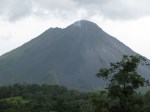
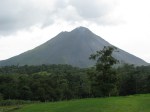
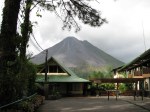
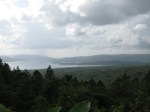
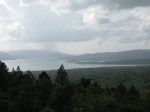
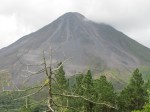
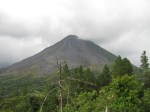
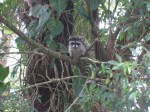
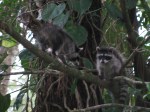
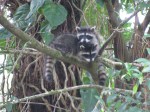
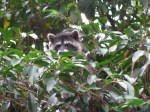
It only took about 15 minutes (including a stop for some afar pictures of the volcano and a stop to see some toucans which promptly flew away as everyone readied their cameras) to get to our destination. Now, I really wish I could recall the name of the hotel that we were taken to, but sadly cannot. The view from the hotel was amazing! We were quite literally up close and personal with the volcano! And to boot, the hotel was quite well landscaped so the views in the near vicinity were also quite spectacular. We were given a little time to wander our new surroundings and take all the views in. The hotel had a deck on the back-end of it that looked onto the volcano and a beautiful lake below. The scenery really was breathtaking! After some time spent on the deck (and several pictures later) we returned to the parking lot to officially start our tour and spotted a family of baby raccoons playing and hanging out in the trees just feet from us!! Needless to say, the next 10 minutes or so were spent cooing over the baby raccoons and taking a gazillion pictures of their every adorable move!! It was hard to tear ourselves away from them, but we were forced to leave the parking lot area soon after that… not because of the tour, but because of the storm that erupted above us raining down buckets of water on us!
Right about now is when the sensible traveler would say “Storm? No worries, I have my poncho or umbrella or rain coat with me!” I however, was not one of the sensible travelers on this day. And even though I did contemplate bringing it with me, I didn’t because the sky looked clear and showed no signs of raining at all! Lesson learned: no matter what the sky may or may not look like at the time, always bring your poncho as at any given moment the weather can shift and go from sun to pouring buckets.
It is for this next reason as well that you don’t want to be caught without a poncho when needed: none of the other travelers had a poncho with them either (except one) and as we all stood huddled under the porch shelter of the hotel, our guide suggested that we purchase a poncho so we could still walk in the rain. Reluctantly one by one we lined up at the hotel desk and purchased a poncho for $2.40 a piece. What we received in return was the thinnest, cheapest and lightest piece of plastic. Seriously it was so darn thin that a couple of people split theirs just trying to get theirs on! Once we were finally all “ponchoed” the guide said “ok, let’s go!”… Where did the guide take us first?? To an indoor room on the second floor of the hotel for a chat about the history of the volcano! By the time we were done with that discussion, the rain had stopped and none of us had any use for the ponchos at all, therefore making the purchase of them completely unnecessary! Hysterical, right?? Or perhaps ironic…
Well, ok I really shouldn’t say that the poncho purchase was completely useless as I have used it since to wrap wet or damp clothing in prior to shoving them in my bag when traveling from one destination to another… But it was useless for the specific intention it was purchased for. But I digress.
Anyway, the chat about the volcano really was quite fascinating. Apparently long ago when people were first settling in La Fortuna, they had no idea that the volcano was indeed a volcano. They lived beside the volcano lake and swam in the waters and climbed the volcano. There never was any issue with this lifestyle until, of course, the volcano erupted and wiped out a good portion of the people there. Those who settled further (and on the ¨correct¨ side of it) from the volcano survived but the majority of the town was completely wiped out. Also, there are actually 4 volcanos all in the same area. The one that is and has been active most recently actually began at the base of the original volcano. As the lava cooled from this ¨base¨ volcano it piled higher and higher until reaching and even surpassing the height of the original cone volcano structure! You can see evidence of this when viewing the volcano from some of the angles, for there seems to be a cone peak that levels off and then it climbs higher to a higher point. The lower cone is the original one, and the higher peak is actually the volcano that is erupting from the base! Pretty cool stuff!! The guide also mentioned how several people have tried to climb up to the top of the volcano since the first eruption that wiped out the original town (1968 if I recall correctly). None were successful and one even died trying.
Once the history lesson was over (and rain) we headed off on foot to our next tour destination: a waterfall! Now it was not the La Fortuna waterfall that is in the National Park, but another smaller one not too far a hike from the hotel we were driven to. Along the way we learned about indigenous plants of Costa Rica such as the citronella (which we all plucked a fruit from and rubbed all over our bodies to naturally prevent mosquitos from dining on us), a cacao plant, banana trees and the Cecropia tree that indigenous tribes used to get high! They would wait for the leaves to fall and dry them out, then smoke them to produce a high. Interestingly enough, it is the leaves of this tree that sloths prefer the most to snack on and it is somewhat of a joke that it’s because they eat these leaves that they are so slow:) Whether the leaves actually produce a high or not, I do not know but it’s certainly interesting information! We were also pointed out a banana spider, which due to my arachnophobia I steered clearly away from and couldn’t even bring myself to take a picture of it for fear it would jump on my camera even from the 10 foot radius of space I gave it.
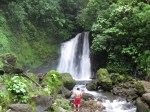
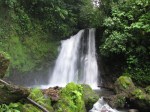
Finally we arrived at our waterfall destination and my, oh my what a sight!! It wasn’t spectacularly tall, but the sound of the rushing water just made your spirits lift and got me very energized!! They are such simple constructions of nature, and yet the force and power of the water rushing off the edge is still awe-inspiring! Our guide promptly upon arriving stripped down to his bathing shorts and decorated his body with mud from the edges of the river, capping his head with a dead Cecropia leaf. The other two men on the tour immediately followed suit while the rest of us (all ladies) one by one surrendered to the idea of getting wet in the chilly waterfall waters. By the end of our time there (about an hour or so) we had all taken our fill of jumping into the waterfall off of nearby logs that had fallen and that now served as great jumping boards, and of taking pictures and generally wading in the river beyond the waterfall. Dark was upon us (which by the way it is pitch dark by 6pm in Costa Rica year round) as we all packed our things up and headed back up the trail to our van. But before leaving the nature hike trail entirely, our guide had one more piece of interesting information for us…
First he asked whether any of us could guess how many spiders and insects were currently in the grassy area directly in front of us. At this question, I immediately froze… My thought was ¨wait a minute, you mean to tell me that you see spiders directly in front of us?!?!?!?! WHERE??? And which way can I go to avoid them?!?!?!?!¨. My first thought was to back up very slowly away from the grass that lay ahead of us, until I realized that there was a ton of grass behind us too so surely there must be spiders in there too!! Now I know of course that there are spiders around us everyday (statistically we are no more than 5 feet from a spider at any given moment in our lives) but I would rather just not know about it! Ignorance to me in this instance is absolutely blissful!! I once again froze and decided, well, perhaps if I knew where they were I could avoid those areas specifically. As people guessed randomly how many critters we were surrounded by, our guide showed us a little trick to find out. We all had headlights with us and we were instructed to place them on our nose and look around our areas with the lights on. This positioning of the light allowed us to look directly onto the beam of light projected from our headlamps and suddenly dozens upon dozens of multiple pairs of little shiny spots all along the grass appeared… What we were in fact seeing was the eyes (sets of 8 for spiders) of insects hidden within the shelter of the grass. It had just rained though so some of those shines were due to water droplets, but I did test out several shiny objects by moving in closer to see what they were and yes, in fact they were bugs or spiders (to my stress mainly spiders!). Quite a useful trick I thought and interesting to boot, even though I again would rather just not know about a spiders presence to begin with.
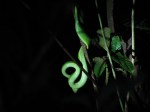
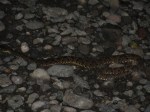
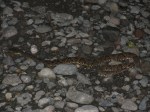
Moving along, we got back to the van and headed out at breakneck speed along the dirt and stone road from which we had traveled before back to town. Speeding and seemingly reckless driving is definitely prevalent in Costa Rica (in fact they are #1 for fatal accidents involving motor vehicles) but you get somewhat accustomed and trusting of tour guides and bus drivers whose job it is to drive tourists around. In any event, at one point on our way back our driver sharply swerved and slammed on the brakes, put the van in reverse and proceeded driving backward for a little ways. When he threw the gear back into drive mode he inched slowly along the road again finally coming to a stop in the middle of the road, just in front of something. He instructed all of us to stay in the van as he got out and looked at a creature ahead of the van lit up only by the lights of the van. After several minutes he returned and stated that there was a real fer-de-lance snake on the road.
I use the word ¨real¨ not to mean that it was alive (though it was) but to mean that it was an authentic one. Apparently there is another snake species that looks very much like the fer-de-lance except that it does not have the triangular head of the real fer-de-lance, but it mimics the authentic one by triangulating its head when it feels threatened to make its predator think it’s more dangerous than it really is. Unlike it’s imposter however, the real (authentic) fer-de-lance is considered to be the most poisonous snake in Costa Rica. As told by several guides, if bitten you have 45 minutes to get anti-venom, and sadly as most hospitals take way more than 45 minutes to get to, chances are if bitten by one it will be fatal. However, upon Google searching info on these snakes myself, I have come across varying information. All do seem to say that it is considered the most dangerous snake in Costa Rica, and that this snake bite is the leading cause of death (among snake bites) but other sources (Wikipedia) state that the fatality rate is almost 0% due to the Clodomiro Picado Research Institute that is responsible for the production of snake antiphidic serums. Hmmmm….
In any event, slowly we all crept out of the van one-by-one to see the fer-de-lance and to snap a few photos (zoom was of course used as I wasn’t going to get THAT close!). Once we all got our picts it was back in the van we went and a little further down the road we once again pulled over to see the next critter spotted by our guide.
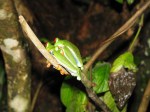
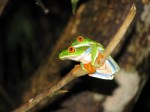
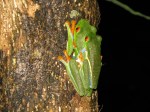
Now perhaps is a good time to say that the tour guides have the most amazing eye sight!!! They are able to spot the tiniest of creatures from the most impressive distances!! This was no exception either as the creature we stopped to see was a pair of mating Red-Eyed leaf frogs!! Chances are you have definitely at least seen a picture of these frogs as they are the most photographed of all the Costa Rica frogs. I know of people who have been here for months and still have not seen one of these frogs in person! The aren’t poisonous at all and are absolutely adorable!! We of course spent probably more time than we needed to photographing them to death (not literally folks, calm down) until resigning back to the van and heading to our final destination: a natural hot spring!
Known only to local ticans (or tourists who are clever enough to ask the locals about whether there are any free hot springs around), the natural (and free!!) hot spring we were taken to was actually a river that prior to the 1968 eruption ran cold, but after ran nice and toasting hot! Just under a bridge where the river ran also naturally formed areas where the water pooled creating a wonderfully perfect jacuzzi! Because the bridge was nearby, you could use the concrete slabs below the bridge as a hot slip and slide dunking off the edge and into the pool at the end. Or if you chose, you could duck under the small waterfall created by the edge of the concrete and the hot pool to a space under the bridge that felt like a sauna!! It did get a little claustrophobic in there for me, so I really just spent the majority of the time lounging in the pool and slip and sliding in from the bridge. We busted out our beers and toasted a wonderful evening out, finally relaxing in the massaging waters.
One funny story here, if you recall we had brought a cooler of beers and all had purchased about 3-4 beers a piece. When we arrived at the hot spring there were two tico (i.e. local) teenage boys playing in the springs already. They hung around as we enjoyed our time there drinking our beers. At one point all of us had ducked under the bridge to the sauna area and when we emerged and decided it was time for another beer, the cooler was still there, but the remaining beer was not… And the boys were gone! Lol!! The guide immediately ran up the river and searched surrounding areas to see if he could find them to no avail and some of my companions were a bit offended, but I just thought it was funny. Typical teenage boy antics- just having some fun! They really didn’t make off with that many beers, so really I didn’t consider it to be too harmful.
In any event, we left the hot spring and were dropped off around 9pm at our relative hotels/hostels. Needless to say I slept quite well that night with my body having been treated so well by the heat and motion of the spring!! Good thing too, as the next day I would once again be departing for my Jeep-Boat-Jeep tour to take me to Monteverde.
On to Monteverde
Back to Costa Rica










 Ramblintraveler